Category: Lamb

  • Pastourmadopita – A dirty pleasure

    Pastourmadopita – A dirty pleasure

    Pastirmas (or pastourmas) is a sausage that is particularly popular in Turkey and generally in the Arab states. Its name comes from the word pastırma et, which means pressed meat in Turkish, possibly because of the custom of nomads and migratory breeds in general, to have meat with them.

    My father who had roots from Asia Minor really loved it and we had him many times cooking it when he was at home.

    Pastirmas is made from the side of the animal. It is usually made from calf, lamb, camel, or buffalo. Better and more expensive, it is considered the camel side pastry.

    The meat must lose all its liquids and then bake with thick salt. It is first placed between two woods that are tightened slowly and more tightly in order the water is drained. At the last stage, the pasted meat is covered externally with a layer called “çemen”, a mixture of spices consisting of cumin, cassava, garlic and paprika. It dries hung in the air, in the sun, for about 30 days, or smokes for shortening of time.

    Many people don’t want to try it because it smells really bed and that is due to the cement, so many remove it before they consume it but thats up to you. It can be eaten with eggs, together with tsipouro, but the best way to appreciate it is the pastrima pie or in Greek “Pastourmadopita” .

    pastourmadopita
    The pastourma pie is ready!

    Ingredients for Pastourmadopita

    • 10 slices of pastirma
    • 2 slices of peppers sliced
    • 200 gr of kasseri cheese or any similar hard cheese.
    • 4 tomatoes sliced
    • 2 tea spoons of olive oil
    • salt/pepper
    • 2 sheets of pastry dough
    • White mushrooms sliced
    • 1 egg
    • Poppy seed (not necessary)
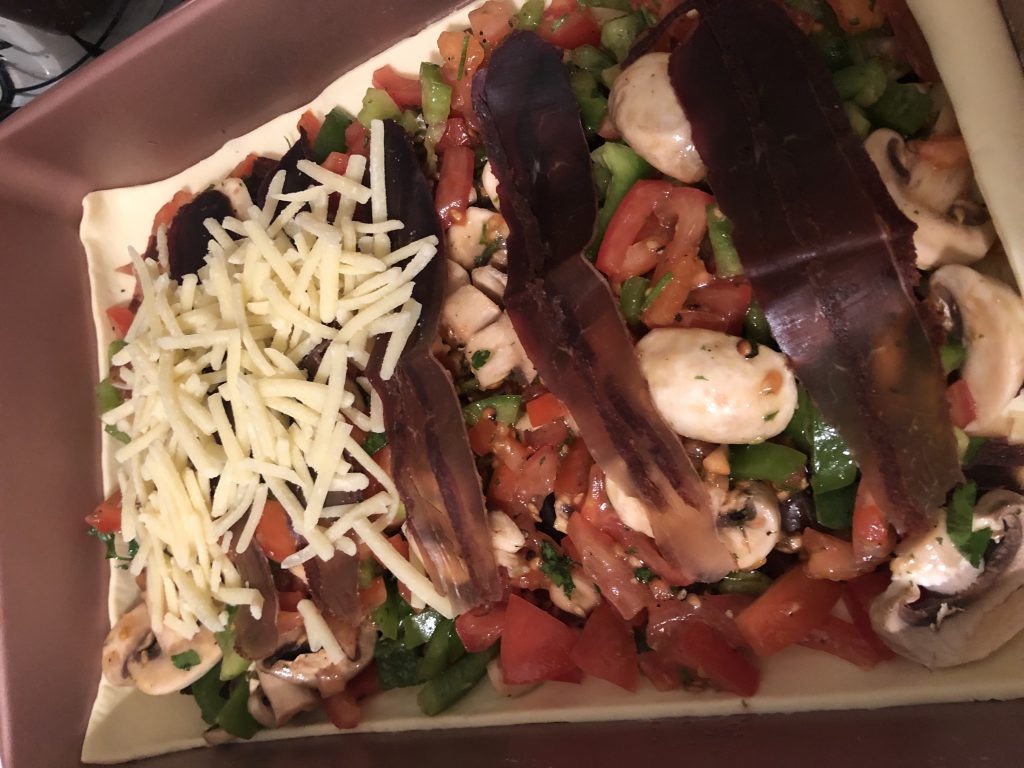
    All of our ingredients and the pastirma on top!
    All of our ingredients and the pastirma on top!

    METHOD

    Pretty simple to be honest… Its always simple if you dont have to make your own dough

    • Lay the first sheet of dough in a deep pan.
    • Start adding all ingredients one after the other. Leave some space in the sides so the sheets can stick together easily
    • Make sure that your remove the liquids from the tomatoes.
    • Break the egg and add the half of it around .
    • Put the second sheet and close it using a fork carefully. Make sure that you don’t leave any spaces. Add the rest of the egg on top and sprinkle it around as this will help “close” the edges of our pie.
    • Sprinkle with poppy seeds on top.
    • Bake for around 1 hour depending on your oven.

    Many are adding various herbs also in the pie but i think that kills a bit the flavour from the pastirma, which should be the main focus. Either way, enjoy!

  • The Greek Burger

    The Greek Burger

    Making a burger is a great dish to make and have together with friends in the weekend, and especially during summer. So the following recipe is my interpretation of a burger with a Greek flavour. Behold the recipe for the Greek Burger.

    (more…)

  • Stuffed Lamb breast with Feta Cheese and Roasted Peppers

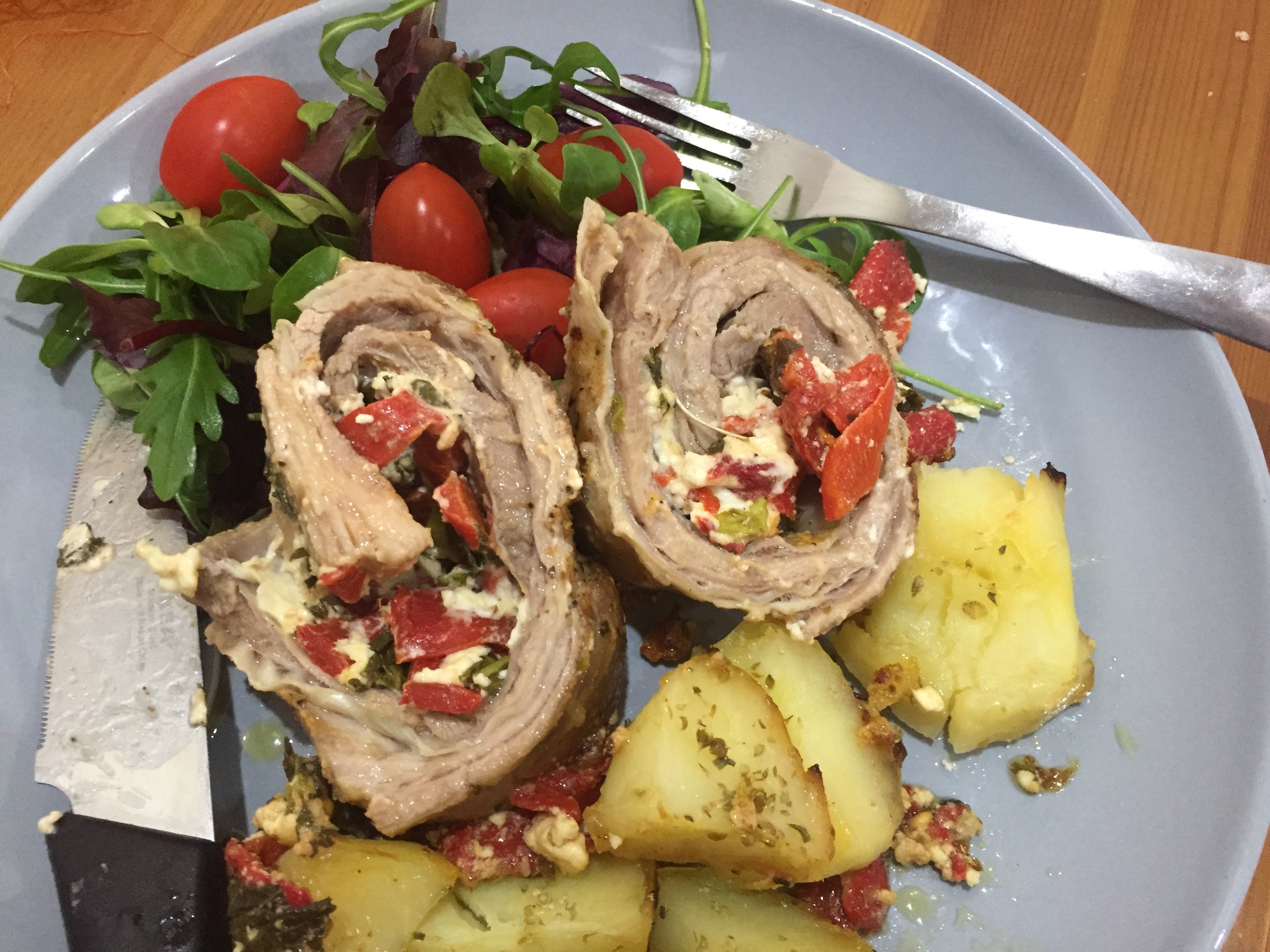
    Stuffed Lamb breast with Feta Cheese and Roasted Peppers

    Sunday in Greece, like in many countries I suppose, is a day for roast meat. Especially lamb! Cooking a roasted lamb mixed with feta cheese though can make the day even better.

    (more…)

  • The perfect “Kleftiko” ! Slow cooked lamb Greek Style!

    The perfect “Kleftiko” ! Slow cooked lamb Greek Style!

    Last summer my manager decided to go for holidays in Greece. He did travel to some places but stayed longer at Paros where he surfed and did try a lot of the local dishes but also  some more traditional ones.  The funny thing was that when he came back he didn’t talked about the sun of Greece neither the sea, or culture etc etc. He talked about the moment he tried first one of the most traditional Greek dishes, the “Kleftiko”.

    (more…)

  • Traditional “Kokoretsi” recipe from Greece

    Traditional “Kokoretsi” recipe from Greece

    Well, if you are Greek and reading this blog, you will know that the following recipe for kokoretsi is one of the most famous in the country during Easter and something that you dont easily do, unless for a celebration.

    Nevertheless, it is something that you can find in some Greek taverns during the year and i think deserves its place in every greek food blog!

    Some people prefer it as a starter, some others as a main meal, it doesn’t make a difference to me…it still tastes the same 🙂 In Greece where i was this year for Easter was our main dish along side our lamb. Traditional it is cooked the first day of Easter and after Greeks orthodox, have come from the church the previous day and tried magiritsa, the traditional easter soup. 

    One of the main reasons you will not find it in any other country of the European union is because the main ingredients are the internal organs of the lamb, heart, liver, lungs and kidneys wrapped in seasoned offals.

    kokoretsi sliced
    Sliced and Ready

    As offal’s (in Greek: Sikotaria) are not allowed in the countries of EU (at least in the UK as far as i know) your only chance is to visit Greece , Turkey or some of the Balkan countries. I am not a doctor to judge whether it is safe or not….but my grandfather was eating that almost every year for the past 91 years of his life and i think he had also one again this year, so it cant be so bad!

    The basic idea is that you put in a long skewer all the organs one after the other and you cover them with offals.

    The offals “protect” them from the heat in a way as the organs inside are cooked on there own liquids. When the offals become brown and cooked then it is ready.

    I am not sure in how many countries can you really cook it as finding the ingredients can be really difficult but if you do find the chance to spend some days in Greece or Turkey be sure to try it…. Many people thought it was disgusting in the beginning but many people loved it in the end…

    INGREDIENTS FOR KOKORETSI

    • 4 kilos of lamb internal organs, including liver, heart, lungs and kidneys
    • 5 kilos of Offals to wrap it

    HOW TO MAKE KOKORETSI

    • We are washing really well all the meat and intestines that we are going to use for the inside part of kokoretsi while in the same time we cut the pieces in small-medium size pieces. More or less the size of an egg.
    • Washing the intestines is the most difficult and tiring part of the process.
    • After we wash them all really good we turn them, inside out in order to clean also the internal ones. There are many ways to do that but the most usual is the method of the needle. Simple, you take a needle, tie it up one place and then push it on the inside of the intestine until it comes up from the other side.
    • If you don’t start the preparation in the same day, the clean intestines should be kept in a pot with water and vinegar.
    • In another pot, you add the pieces of meat (sikotaria) and you start the seasoning.
    • Hit in a blender 3-4 cloves of garlic with 1 spoon of olive oil.
    • Add Salt in the sikotaria and oregano but not too much.
    • Now add the garlic and stir so all the ingredients go everywhere.
      Let it relax for an hour or so. .
    • Now its time to pass everything in the spit or the “beloniasma” as it called in Greek.  You need to add in turns, hearts, liver, bolia and additional intestines you might have making sure that they are really close one another without being in the same time really tight.
    • When you do that then you need to cover all the parts with the intestines. So you get the point, the hearts,liver etc will be inside protected from the fire and the intestines will cover them on the outside.
    • What you wan to do is take one long intestine and tie it up on the bottom side of the spit and slowly pass it round the spit until the upper side where we will have to tie them up again.
    • We repeat the same procedure going up and down making sure that we cover as much as possible all sides.
    • As we go on we will notice that some pieces of meat will be poping out of the intestines.  We need to make every effort to cover them too.
    • When we finish with it we need to leave it standing for at least 2-3 hours in order that any liquds are removed from the meat. I remember my father and my grandfather leaving it in the previous night but it depends if you have time to do it.
    • You need to have  prepared a proper fire to cook it and that is really important as from that the amount of time for the cooking Depending on the size of kokoretsi and the fire you are looking at around 2.5 -3.5 hours.
    • You need to place it really far away from the fire in your barbeque so it can be cooked slowly and internally.  You place it lower and closer to the fire only during the end so you can have the crunchy feeling on the outside.