Category: Blog

  • The biggest Food Fights in the world

    The biggest Food Fights in the world

    Do not play with your food! That’s what parents always told us at the table, but if you look, you’ll find there are many places in the world where playing with food is not only welcome but also real fun.

    There are many food festivals around the world where you can go and taste the local delicacies. However, i found it more interesting when you can go and enjoy it in such a way like in a food fight.  Spain for some reason might have lions share on those festivals but all over the world you can find interesting customs you go and visit. 

    La Tomatina –  Buñol (Spain)

    La fiesta de La Tomatina
    La fiesta de La Tomatina

    Each year on the last Wednesday of August, in a city west of Valencia in Spain, one of the most famous food festivals of the world takes place. The famous La Tomatina festival comes to the Spanish town of Buñol.

    It is a huge food war, with a history that goes back over 70 years and brings together thousands of people who literally throw tomatoes to each other in the central square of the city. During the festival, the population of the city, which is normally 10,000 inhabitants, is quadrupled by tourists. The celebration lasts for a week and includs performances, music, dance and fireworks.

    How did the festival begin?

    According to the local legend you need to go back to 1945. A small disagreement between two young farmers turned into an open battle with tomatoes in the central square of the city, motivating passers-by to participate. Her success has inspired another food festival, Battaglia delle arance

    Battaglia delle Arance – Ivrea (Italy)

    If you do not like tomatoes then maybe you should try the “battle of oranges” in the northern Italian city of Ivrea. There the story of a local rebellion against the Raineri di Biandrate tyranny revives every year, with oranges replacing the weapons.

    This baron was expelled to the Middle Ages during a public revolt as the city was starving under his tyrannic ruling.  The revolt is reproduced and takes place during the city’s carnival in February. Two parties take part in this epic three-day struggle with food. Participants throw over 250 kilograms of oranges to each other during the battle, and vehicles and snow removal equipment are usually recruited to clear the road after the festival.

    Every spectator is encouraged to purchase and wear, at all times, the Berretto Frigio/Phrygian Cap/red hat for “protection.” Wearing the hat signifies that you are part of the revolutionaries and will protect you from getting oranges directly thrown at you. 

    If you don’t… 

    Els Enfarinats – Alicante (Spain)

    Els Enfarinats

    Moving on to our third city. Each year, on December 28th, Ibi town in Alicante, Spain hosts the famous fight known as Els Enfarinats, meaning “those covered with flour”.  The festival is always on that dato coincide with the Day of the Innocents, the equivalent of April Fools’ Day.

    Your weapons: eggs, flour and fireworks.

    This famous food fight has a history of 200 years and takes place between two groups. The Els Enfarinats are a group of married men who have the sole duty to enact ridiculous laws for one day and the other group, La Oposicio, have a duty to restore order.

    The two opponents are fighting outside the City Hall to prove their strength, through a dirty but entertaining clash with eggs and flour “bombs”.

    World Custard Pie Championship – Kent (England)

    world custard pie championship

    England is not famous for there cuisine. However, they are famous for there pie’s and the world custard pie championship that takes place in Kent every June. 

     This festival, which began as a way to raise money for the town hall of the city 49 years ago, evolved and attracted many visitors. Participants are divided into groups of 4 people and each player must cast the pie with his left hand, to his opponent. 

    He will win:

    • six points if he succeeds in the opponent’s face,
    • three for points from the shoulder and above
    •  one point for any other part of the body.

    Simple huh?  Get ready for some tough competition though.  In 2018 more than 2000 custard pies were thrown while 32 teams competed, 3 of them from Japan

    Merengada – Barcelona (Spain)

    la merengada
    la merengada

    Again in Spain, as it seems to have the lion’s share in the Fighting Festivals.

    At this delicious party on the streets of Vilanova i la Geltrú in Barcelona you will see people throwing about 90,000 pounds of sweets and meringues. It dates from the 1940s when Franco banned carnival events. In retaliation, the locals protested on Thursday before Lent and dropped sweets to show their anger.

    Expect to be surrounded by local children, who are given the day off from school to participate in the sugary battle. Most poncho-clad participants arm themselves with pastry bags filled with the sticky sweet. The messy, fun-filled day culminates with an evening meal of xató, a traditional Catalonian dish resembling a tuna salad that’s topped with a nutty garlic sauce.

    The Great Fruitcake Toss – Manitou Springs (US)

    The Great Fruitcake Toss

    Obviously when we are talking about food fights we should include the US. It’s not the dirtiest and the most sticky of the festivals but it’s definitely a lot of fun.

    In Manitou Springs in the US, they will not let you eat these fruit cakes but they will use from catapults to … cannons and any other gadget they can think about to launch them.

    This one-of-a-kind event, where enthusiasts traveled from all over to compete for trophies and bragging rights, has been a community highlight for more than 22 years. The great fruitcake toss is the event of the winter season as the hapless dessert is launched into space with a variety of mechanical and pneumatic devices.

    But that is not just all.  After the fight there will be also a local bake off competition.  Local bakers will compete for the title of Fruitcake King or Queen as determined by the community. Winners will be based off who makes the best organic, non-GMO, natural fruitcakes. 

    Batalla del Vino – La Rioja (Spain) 

    batalla-del-vino

    Another celebration in Spain: Every year, on 29 June, La Batalla del Vino “rolls” to the village of Haro, La Rioja.

    The day begins at 9:00 am, with a procession of people old and young,all carrying jugs, bottles, botas and other types of containers filled with red wine. Led by the town’s mayor, on horseback, the procession winds through the town to the Cliffs of Bilibio, where a mass is celebrated at the Hermitage of San Felices de Bilibio.

    After the mass a true free-for-all begins, with everyone tossing wine on each other until all are soaked from head to foot. Then at noon everyone returns to town to celebrate at the Plaza de la Paz, followed by bullfights in the town’s bullring. But the bullfights are only for the youth, and the “bulls” are actually just heifers. Also, none of the heifers are killed

    https://www.youtube.com/watch?v=dw70DqzX2II

    Participants must wear white clothes and roll in red wine until their clothes become red. This celebration goes back to the 13th century when two regions, Haro and Miranda de Ebro, fought for their borders. Haro warriors held dark red banners and for the next 400 years that their victory is celebrated, the celebration arrived from a glass of wine to…bathing with a wine.

    The Flour fight – Galaxidi (Greece)
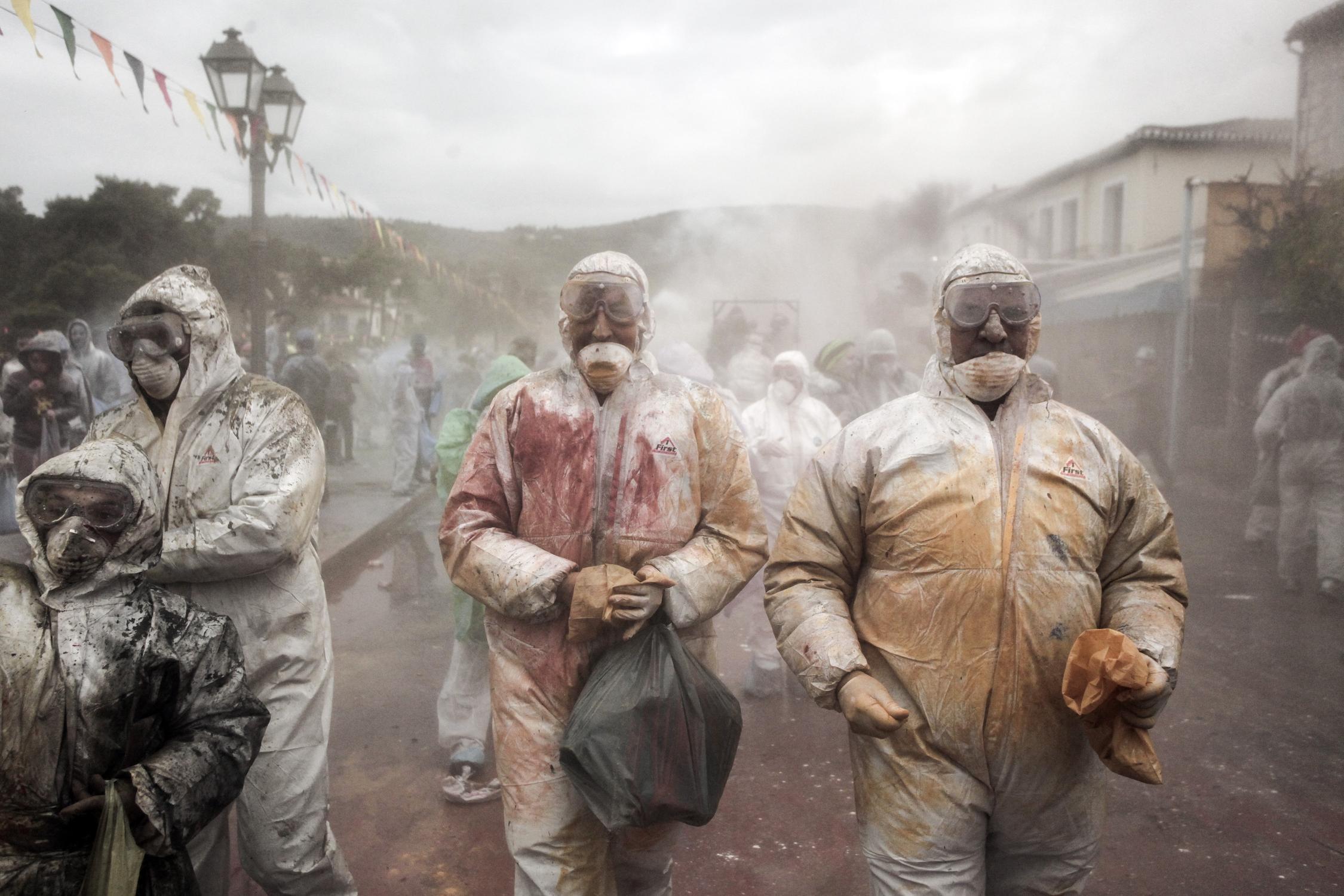
    flour fight galaxidi greece

    This article wouldn’t be in this blog if we didn’t included at least one fight in Greece. Last but not least our own “flour fights” in Galaxidi.

    The fight marks the first day of Greek Orthodox fasting and the end of the Carnival period and it is a real flour-free warfare. Residents and tourists bombard each other with white and colored flour bags that make them all look like ghosts.

    The custom is believed to have been born in 1801 when the inhabitants of Galaxidi defied the Ottomans who occupied Greece by celebrating the forbidden carnival and painting their faces with ash while diving in the streets.

  • Reasons to visit Greece: As being told by tourist/expats

    Reasons to visit Greece: As being told by tourist/expats

    Because  of my profession i spent a lot of time online scanning through the internet and looking about …more or less everything that i need at that time. It gave me great pleasure to read a post in quora.com on the impressions of tourists for Greece.

    Quora is a question-and-answer site where questions are asked, answered, edited, and organized by its community of users.  Basically you can go and ask more or less anything you want and people from the community will come back with an answer. Hopefully correct!

    So even if it biased from each ones experiences it gives us a nice insight on what Greece could give you if you decide to spend some days there.  Some of the answers provided are huge and will not post all of them over here but will try to focus on some parts.

    Samuel Chan is from California and he has been to Greece 5 times as he is working  for a company founded by a Greek and half of the team is based out of Greece.  Here is what he thinks about Athens.

    “Since the majority of my time here in Greece is spent in Athens, I’ll share some of my impressions of this city too.Athens is huge. Over 3.5 million people live here, but it never feels crowded or like you’re in such a big city. If you go up to the Acropolis or another place that overlooks Athens, you’ll understand the true scale of the city. Houses go as far as your eyes can see in every direction.

    Athens feels rather different than other European cities I’ve been to (Copenhagen, Paris, Zurich). It’s got a long history and certainly feels a bit aged (I mean, one of the oldest and most beautiful buildings in the world stands here!). Houses, which usually have 6-12 apartments inside, tend to be slightly plain and boxy. But the apartments themselves were spacious and comfortable; all had balconies that overlooked the street outside.

    The first thing my co-worker and friend told me when I arrived in Athens was that cars have right-of-way over pedestrians. I chuckled, but it’s a true statement. Streets, particularly those in residential areas, are narrower than American roads, and cars can go pretty fast, so you have to be cautious and patient when crossing a road.

    As big as Athens is, it has a convenient public transportation system that was quite easy to understand. I can hop on the train/metro and get from the eastern side of Athens (in Iraklio) to the Piraeus port in 45 minutes for 1.40 Euros. Most metros are colorfully covered by graffiti, making each one a unique piece of art.

    Taxis are also quite cheap (compared to the US). A ~25 minute ride cost 9 Euros.

    After walking and taking the metro everywhere, I dread having to drive everywhere once I return home.

    If you ever spend a night in Athens, you’ll find that it’s a city that never sleeps. The first time I was in Athens, I was jet lagged and could hear cars constantly driving through a main street at 3 and 4am. I’ve also gone out with friends and stayed out till 6 am.

    Athens is quite safe too. I’ve walked alone at 2am and had no issues (I’d probably never try this at home.)”

    Not sure how safe is walking alone at 2 am in California but i would agree with his view on Athens (of course i would i am from Athens…)  . Either way, after living in London for more than 10 years i have to say that Athens and Greece is mostly portrayed badly in the media whenever there is a protest or any political riot. The 8 years of depression hasnt helped either. Nevertheless, you very rarely see or hear attacks in tourists or fights breaking up  like -for example- every Friday night in central London.

    Obviously, in there we have also some comments of people that love Greece but in the same time reveal some of our negative aspects of our character.  Bob Harnet, is married to a Greek and talks about it in more detail .

    “Greece is a great place to visit, the weather is consistent and the people are quite friendly. There is a better than average use of English in Greece (for tourists) than other countries I have visited but less than more developed countries. The Greeks have possibly the worst public toilets in the Western world, seriously guys, sort it out, this includes bars/restaurants/etc.

    Greek food is pretty universally acceptable and quite diverse. Greeks may not understand vegetarians but there is enough diversity of food on the menu to satisfy, more than many other countries. The food is rarely refined which is a shame not to have much choice in venues, it is mostly either souvalki/gyros or taverna/ouzeria. The quality of food is nearly always good.

    Lounge bars are great, much missed in other countries. Just chill with a drink and some good music.

    Greeks take almost no pride in architecture, history perhaps but anything newer than 1000 years old is happily neglected, then knocked down and replaced with a concrete apartment block. There are some fabulous old buildings around Greece I am slowly watching crumble away. I wish there was some heritage charity in Greece looking to save these forgotten gems. (This excludes tourist areas that get preserved not for their merit but because they bring tourists).

    Greeks assume someone else is responsible for everything and nothing is within their power. Corruption, graffiti, infrastructure? When government fails the people should step up and do it, not just complain and vote in another useless group.”

    I would definitely agree with him on the architecture part. Unfortunately, Greece (and especially Athens) has grown tremendously in the past few years which had a huge negative result in the buildings and the life of Greeks. A lot of things should be done on that but not sure how to start.

    As far as the last paragraph , i would say it is a bit more complex.

    Tamas Remenyfy, wrote 5 reasons why you should visit Greece.

    1. Beaches. Greece has the longest coastline in Europe (more than 13 thousand kilometres), therefore you can choose from thousands of beautiful beaches with crystal clear water.

    2. The weather in Greece is ideal for a summer holiday.

    3. The prices are relatively cheap compared to other southern European countries such as Italy or Spain.

     4. Greek mediterranean cuisine is nice and healthy, greek salad, fish dishes, grilled meats etc. If you are a lover of blue sea and sunshine, Greece is definitely a great vacation spot for you.

     5. Last but not least Greece offers great historical sites to visit.

    On the other hand Ashwini Mina, focused on our driving skills and on our taste of…art.  “The average driver in

    Greece can easily out-beat the best in the rest of the world. The reason is the huge traffic which requires exceptional parallel parking skills. Add a humongous bunch of traffic signals to the situation and it was a bit of chaos….

    The streets were littered with Graffiti – Some were negative messages because of the economy.  There was also a lot of police presence on the roads.Overall, it’s a beautiful country and definitely plan to visit again.”

    I cant say the comments are bad, or wrong but it is the opinion that is portrayed online. Sometimes this opinion has be defined by  personal opinion and some others because of the news. Either way, it is good to have it in mind. Closing i fight quite positive that even if some negatives of our character as Greeks were portrayed (which is normal) almost all of them talked about how they would visit Greece again.

    Last statement from Alan Cowperthwaite.

    souvlaki

    “Greeks are noisy, friendly and incredibly hospitable.  For example someone I had spoken to on a professional level found I was flying to Greece, phoned me  and insisted he would meet me at the airport and stay with him. We had never met before! My parents were driving in Crete in the mountains when people stopped the car, explained that there was a wedding and insisted they come as guests. I had stopped in a little town to get something from a shop and a man with a big silver platter followed me in and insisted I had some of the food. ( I think it was an occasion that takes place 30 days after a funeral). If you are a stranger, you are a guest, the word is the same, Xenos.

    Food l would describe as fairly simple, but with good fresh ingredients. The best way to eat in local restaurants/tavernas is to go into the kitchen, see what Mamma is cooking and choose it there. On a hot day nothing beats a good Greek salad with good bread to soak up the tasty olive oil. The best lamb I have ever had was from a nondescript taverna in the Cretan mountains,  a whole lamb had been slow roasted on a spit over a wood fire for hours and was so tender you didn’t need a knife. I am quite fond of retsina when I am there, though it doesn’t taste the same in a different environment.

    The scenery and history are fascinating, most of the tourist poster photos  one sees of Greece are taken on Santorini. It’s stunning, I took a day trip there and used 5 rolls of film and wished I had more!”

  • The art of cooking an octopus

    The art of cooking an octopus

    Watching an octopus hanging out of a tavern in Greece is  one  of the iconic photos -at least for me- of my country during summertime. The bigger it is the better chances this tavern has to convince to go and sit in one of its tables.

    Eating an octopus in any different way its one my favorite dishes during summer.  However, it is also one of the most difficult to cook especially if you decide to grill it or boil it. If you over do it , then it might be too hard, or too chewy and miss the opportunity to enjoy one of the best dishes in Greece.

    My initial inspiration about this post was the following post on Instagram where it shows this chef cutting down a huge octopus.

    A post shared by ♨CHEFS247? (@chefs247) on

    Cooking an octopus might seem as something really difficult and intimidating for someone that hasn’t done before but it really isn’t. The magnificent octopus measures up to 80cm and has eight succulent tentacles which are each a feast waiting to happen.

    In Greece fishermen and generally in the taverns are know to beat the octopus in the rocks before they cook it in order to soften it up. As i read, some chefs also tend to put it in a bag and pop it in a quick spin on the washing machine but i don’t think you should go so far.

    Is Octopus Good For you? 

    Yes, it is! Low fat. Octopus is great because it contains very low amounts of saturated fats.This means that it can be a great option for someone who want to lose weight or someone who just wants to keep being fit.100 grams of octopus has only 160 calories even if it is high in cholesterol.Another advantage is that octopus contains many healthy nutrients.

    How you cook an octopus?

    Whether you choose a frozen or fresh octopus there are different options but i have to say frozen in this case makes it easier for us. It might seem counter intuitive since with many types of meat and seafood freezing can have a negative effect on both texture and flavor, but with octopus (and squid), that is not the case.  Grilling it is also great but my favorite is boiling it.

    Fill a saucepan with salted water and bring to the boil. Add the octopus, reduce the heat immediately and simmer gently for 45 minutes. It’s important that the water is turned down to a gentle simmer once the octopus is in the pan. Cooking it too quickly will result in a rubbery texture.

    In order to make  sure whether it is ready or not use a knife and stick it to the thicker parts of its tentacles. If it is easily pushed inside then its good to go.

    However, that is not the only way to do it and many times people prefer it as a pickle. My father certainly does and he has made it many times for me as you can see over here.

    How to clean the octopus? 

    That is what gets everyone scared when it shouldn’t. If your octopus is not pre-cleaned: Wash and clean your octopus, removing the ink sac and internal organs by making a circular cut around the beak with a paring knife and pulling it away (the organs will come with it).

    The flavor of the octopus is really delicate and you will need to season it really well and add plenty of virgin olive oil in order to reveal its texture and taste. If you want inspiration try to mix it with pasta and additional seafood but remember always that it is also ideal as a standalone plate.

    Octopus with Fava in Greece

    Whatever you choose you need to remember that eating an octopus is a really tasty experience which should tried more often.  Additionally to that, remember,  it is one of those seafoods that can last in your fridge a bit more than all the others.

    Just don’t forget to drink some ouzo and you should be fine!


  • 5 Customs you can experience in Greece during Easter

    5 Customs you can experience in Greece during Easter

    During Easter, events and Christian customs take place to celebrate Easter, the most important celebration of Christianity all over Greece. Have you wondered how it is celebrated in different regions of Greece? There are some very special customs that you will meet in different parts of the country. In this post  I stand out a few and present them to you.

    The celebration take place this year on Sunday 8th of April.

    (more…)

  • What is the “Greek Food”

    What is the “Greek Food”

    In the past 5 years i keep this blog i tried to have an open mind on other cuisines but also tried to learn a bit more about the origin of the Greek cuisine and what is exactly that characterised it.  It is important to know what distinguish one cuisine from another not because you want to put your mark on a recipe but because you want to understand a bit more about the history of the people and the country.

    (more…)