It is tradition…now a days in my family , that my mother always send me the traditional vasilopita or Billy pie in English, to have it on New years Eve.
January 1st is the name day (saint’s day) of Aghios Vassilis (St. Basil), the Greek Santa Claus, and the cake is named in his honor. While Christmas is a more solemn occasion in Greece, January 1st is filled with celebrations and the exchange of gifts. Additionally it’s the day where we cut the Vasilopita and exchange gifts.
Each Vasilopita is baked with a coin or medallion hidden inside which, according to tradition, will bring great good fortune in the new year to the person who gets it.
Traditionally, the pieces are cut by the father of the family and allocated to the church, then the father,the wife and the children. Lastly, we even used to cut one for our dog..but i guess that was just us, not everyone in Greece would probably do it..
In the last few years my mother would bake one vasilopita with chocolate on top which makes it even yummier.. but more on the recipe on another blog.
During Christmas there are two cookies that were and still are very much traditional in our house. Eating isli and kourabiedes. While i have covered the first in a previous article it is time i think to focus on the latter.
Kourabiedes are cookies that are dived in sugar and because of there white appearance are really popular during Christmas. When you see them, they may resemble light and airy shortbread, but are made with the addition of almonds. Almonds are the most important ingredient in a Kourabied, and provide the cookie’s signature almond flavor. Other ingredients include large amount of butter, as well as flour, sugar, salt, and vanilla extract, among others.
https://www.instagram.com/p/BdJcVxiHlXx/
In the past few years i always remembered my mother experimenting with kourambiedes and trying to create a less sugary version of them.
Start by roasting the almonds. Place the roughly chopped almonds on a baking tray and sprinkle with some water. Bake them for 7-8 minutes, until roasted, being careful not to burn them. Set aside or put in the fridge to cool down
In the mixer continue by “hitting” the butter with the powdered sugar for 10 minutes until they become cream.
Add one by one the eggs, the vanilla and soda. Afterwards, 2-3 spoons of flour so the mixture is ready to accept the cognac. Afterwards, we add the almonds.
Now its time to add the rest of the flour slowly from the sieve. Continue to mix, until the flour is soaked. Be careful though not to over do it.
Take slowly and make small -bit flattish- balls of 30gr each. Put them in the oven and bake them on 170c for 20 minutes.
As we bake them, in a small pot, we melt around of 200gr of white chocolate.
Do not play with your food! That’s what parents always told us at the table, but if you look, you’ll find there are many places in the world where playing with food is not only welcome but also real fun.
There are many food festivals around the world where you can go and taste the local delicacies. However, i found it more interesting when you can go and enjoy it in such a way like in a food fight. Spain for some reason might have lions share on those festivals but all over the world you can find interesting customs you go and visit.
La Tomatina – Buñol (Spain)
La fiesta de La Tomatina
Each year on the last Wednesday of August, in a city west of Valencia in Spain, one of the most famous food festivals of the world takes place. The famous La Tomatina festival comes to the Spanish town of Buñol.
It is a huge food war, with a history that goes back over 70 years and brings together thousands of people who literally throw tomatoes to each other in the central square of the city. During the festival, the population of the city, which is normally 10,000 inhabitants, is quadrupled by tourists. The celebration lasts for a week and includs performances, music, dance and fireworks.
How did the festival begin?
According to the local legend you need to go back to 1945. A small disagreement between two young farmers turned into an open battle with tomatoes in the central square of the city, motivating passers-by to participate. Her success has inspired another food festival, Battaglia delle arance
Battaglia delle Arance – Ivrea (Italy)
If you do not like tomatoes then maybe you should try the “battle of oranges” in the northern Italian city of Ivrea. There the story of a local rebellion against the Raineri di Biandrate tyranny revives every year, with oranges replacing the weapons.
This baron was expelled to the Middle Ages during a public revolt as the city was starving under his tyrannic ruling. The revolt is reproduced and takes place during the city’s carnival in February. Two parties take part in this epic three-day struggle with food. Participants throw over 250 kilograms of oranges to each other during the battle, and vehicles and snow removal equipment are usually recruited to clear the road after the festival.
Every spectator is encouraged to purchase and wear, at all times, the Berretto Frigio/Phrygian Cap/red hat for “protection.” Wearing the hat signifies that you are part of the revolutionaries and will protect you from getting oranges directly thrown at you.
If you don’t…
Els Enfarinats – Alicante (Spain)
Moving on to our third city. Each year, on December 28th, Ibi town in Alicante, Spain hosts the famous fight known as Els Enfarinats, meaning “those covered with flour”. The festival is always on that dato coincide with the Day of the Innocents, the equivalent of April Fools’ Day.
Your weapons: eggs, flour and fireworks.
This famous food fight has a history of 200 years and takes place between two groups. The Els Enfarinats are a group of married men who have the sole duty to enact ridiculous laws for one day and the other group, La Oposicio, have a duty to restore order.
The two opponents are fighting outside the City Hall to prove their strength, through a dirty but entertaining clash with eggs and flour “bombs”.
World Custard Pie Championship – Kent (England)
England
is not famous for there cuisine. However, they are famous for there pie’s and
the world custard pie championship that takes place in Kent every June.
This
festival, which began as a way to raise money for the town hall of the city 49
years ago, evolved and attracted many visitors. Participants are divided into
groups of 4 people and each player must cast the pie with his left hand, to his
opponent.
He will
win:
six points if he succeeds in
the opponent’s face,
three for points from the
shoulder and above
one point for any
other part of the body.
Simple huh? Get ready for some tough
competition though. In 2018 more than 2000 custard pies were thrown while
32 teams competed, 3 of them from Japan
Merengada – Barcelona (Spain)
la merengada
Again in
Spain, as it seems to have the lion’s share in the Fighting Festivals.
At this
delicious party on the streets of Vilanova i la Geltrú in Barcelona you will
see people throwing about 90,000 pounds of sweets and meringues. It dates from
the 1940s when Franco banned carnival events. In retaliation, the locals
protested on Thursday before Lent and dropped sweets to show their anger.
Expect to
be surrounded by local children, who are given the day off from school to
participate in the sugary battle. Most poncho-clad participants arm themselves
with pastry bags filled with the sticky sweet. The messy, fun-filled day
culminates with an evening meal of xató, a traditional Catalonian
dish resembling a tuna salad that’s topped with a nutty garlic sauce.
The Great Fruitcake Toss – Manitou Springs (US)
Obviously
when we are talking about food fights we should include the US. It’s not the
dirtiest and the most sticky of the festivals but it’s definitely a lot of fun.
In
Manitou Springs in the US, they will not let you eat these fruit cakes but they
will use from catapults to … cannons and any other gadget they can think
about to launch them.
This
one-of-a-kind event, where enthusiasts traveled from all over to compete for
trophies and bragging rights, has been a community highlight for more than 22
years. The great fruitcake toss is the event of the winter season as the
hapless dessert is launched into space with a variety of mechanical and
pneumatic devices.
But that
is not just all. After the fight there will be also a local bake off
competition. Local bakers will compete for the title of Fruitcake King or
Queen as determined by the community. Winners will be based off who makes the
best organic, non-GMO, natural fruitcakes.
Batalla del Vino – La Rioja (Spain)
Another
celebration in Spain: Every year, on 29 June, La Batalla del Vino
“rolls” to the village of Haro, La Rioja.
The day
begins at 9:00 am, with a procession of people old and young,all carrying jugs,
bottles, botas and other types of containers filled with red wine. Led by the
town’s mayor, on horseback, the procession winds through the town to the Cliffs
of Bilibio, where a mass is celebrated at the Hermitage of San Felices de
Bilibio.
After the
mass a true free-for-all begins, with everyone tossing wine on each other until
all are soaked from head to foot. Then at noon everyone returns to town to
celebrate at the Plaza de la Paz, followed by bullfights in the town’s
bullring. But the bullfights are only for the youth, and the “bulls”
are actually just heifers. Also, none of the heifers are killed
https://www.youtube.com/watch?v=dw70DqzX2II
Participants
must wear white clothes and roll in red wine until their clothes become red.
This celebration goes back to the 13th century when two regions, Haro and
Miranda de Ebro, fought for their borders. Haro warriors held dark red banners
and for the next 400 years that their victory is celebrated, the celebration
arrived from a glass of wine to…bathing with a wine.
The Flour fight – Galaxidi (Greece)
This
article wouldn’t be in this blog if we didn’t included at least one fight in
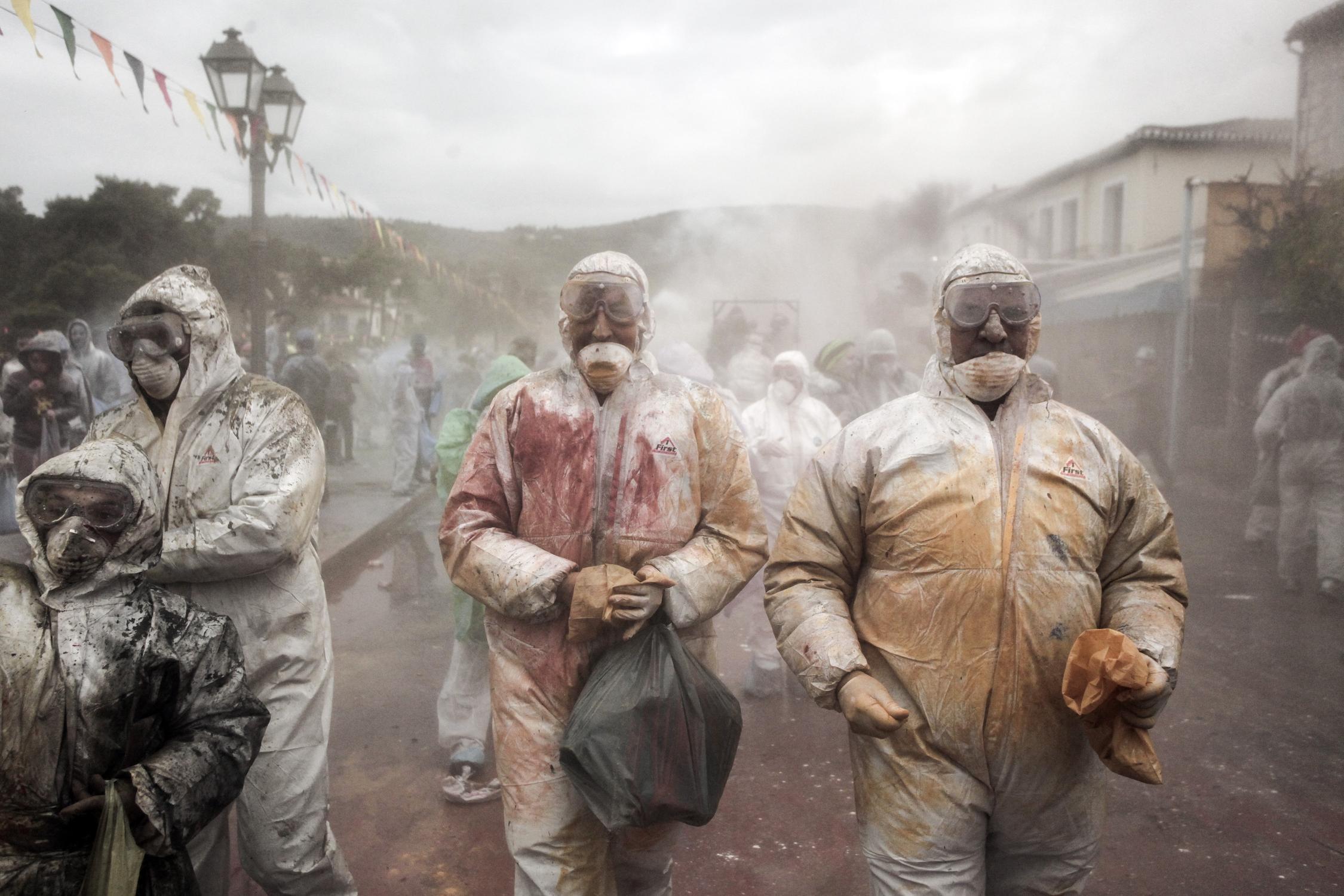
Greece. Last but not least our own “flour fights” in Galaxidi.
The fight
marks the first day of Greek Orthodox fasting and the end of the Carnival
period and it is a real flour-free warfare. Residents and tourists bombard each
other with white and colored flour bags that make them all look like ghosts.
The
custom is believed to have been born in 1801 when the inhabitants of Galaxidi
defied the Ottomans who occupied Greece by celebrating the forbidden carnival
and painting their faces with ash while diving in the streets.
A weekly dose of olive oil could be better than Viagra at
helping boost a man’s performance in the bedroom, new research suggests.
Scientists from the University of Athens says just nine
tablespoons of the popular condiment is enough to reduce impotence by around 40
per cent.
Olive oil has a wealth of health benefits including keeping
blood vessels healthy and maintaining circulation throughout the body.
A study of 660 men with an average age of 67 found that
those that adopted a Mediterranean style diet – rich in fruit and vegetables,
legumes, fish and nuts, as well as olive oil – had far fewer problems in
between the sheets and even saw a vast improvement in their bedroom prowess.
Olive oil can also help dramatically increase testosterone
levels, which reduces the risk of erectile dysfunction, which is the inability
to get and maintain an erection sufficient for sexual intercourse.
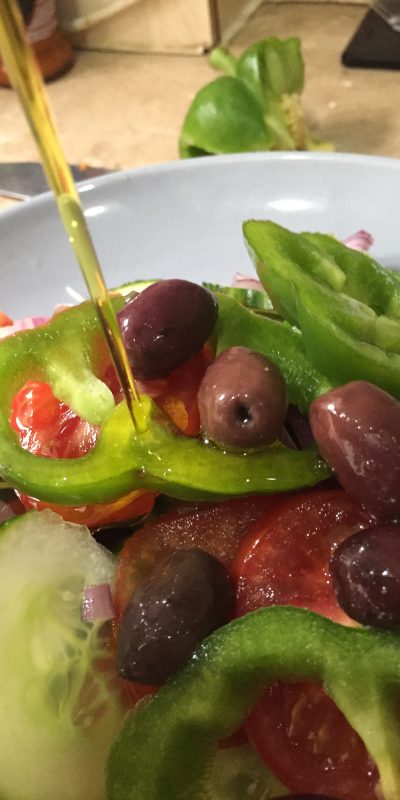
Traditional Greek Salad is rich in olive oil
According to the NHS, one in five British men over 40, the
equivalent of 4.3 million men across the UK, are effected by erectile problems.
Tiredness, anxiety, and drinking too much are just a few of the contributing
factors.
Lead researcher Dr Christina Chrysohoou, said diet and
exercise were key to improving sexual capacity of middle age and elderly men.
“Men that follow a Med diet – particularly consuming lots of
olive oil – see their risk of impotence reduced by up to 40 per cent in older
age.”
Dr Christina Chrysohoou
She added that small lifestyle changes could prove more
beneficial for those looking for a long-term solution. While Viagra, created in
the 1990s and now available over the counter without prescription in the UK,
has helped the the sex life of millions, the side-effects include headache,
back pain and visual disturbance.
“This diet keeps your
blood vessels healthy and lowers the risk of metabolic syndrome, such as
diabetes, high blood pressure and central obesity.
Dr Christina Chrysohoou
“It offers men a long-term solution without taking any
medication, such as Viagra. This diet keeps your blood vessels healthy.
Dr Christina Chrysohoou
“Viagra does not improve something long-term. It can
only give some short effect in order to have sexual capacity.”
Julie Ward, of the British Heart Foundation,
welcomed the findings, saying “It’s no surprise the Mediterranean diet – which
we know is beneficial to heart and circulatory health – might benefit blood
vessels and help men maintain healthy sexual function
Cooking with greens is something really typical in Crete, one of the most traditional islands of Greece. The following beef stew with chard can be found in the island in many variations equally tasty.