Some of the recipes are but classic. There are so many modifications around those recipes that are sometimes difficult to keep up.
I cant even remember the amount of different combinations my mother made with beef stew and red sauce. To be honest it doesn’t really matter as there were always nice
You can have beef with peas or okra or just with chips. I think if you take a look in a Greek recipe book you will find so many modifications that after a while you will be really bored of cooking
On the other hand if you do it right then you always have a nice dish that you can enjoy for yourself or your friends.
Well either way that’s another modification that I did recently and one I did believe it really worth the effort as it is really easy to make as most of the nice foods. Really important thing is the pasta on this one, to be honest I don’t remember how this pasta is called but well you can find it I guess. I just enjoy the small pasta combined with meat.
PASTA AND BEEF WITH RED SAUCE
Ingredients
Around 500gr beef
Pasta…well that one
1 can of tomato juice
1 chopped Onion
1 clove of garlic chopped
A small spoon of thyme
Olive oil
Salt and pepper
Shredded feta cheese
Method
Step 1
Start making your pasta in a different pot In the same time in another pot add the olive oil and the onions with the garlic in high heat As it becomes a bit brownish then add the beef and stir it
Step 2
When the beef is also brown add half a glass of red wine and lower the heat. Add also the thyme and stir it so it goes all over the place. Add salt and pepper also. Let it for 5 minutes and smell the flavours of the wine and thyme
Step 3
Add the tomato juice and let it boil. Add some water if it is needed. When the beef is soft and tender then add the pasta and stir it so it can go everywhere..Serve with adding the shredded feta cheese.
There are some times that you have an idea on your mind for too long and you are just not sure how to compete it.
In Greece having fried courgettes is a classic appetizer that you can find in many taverns. The classic way to make them is to have them cut in slices and fry them while you have covered them in a mixture of flour and beer.
Which is pretty nice but since I had a whole Sunday where I didn’t had anything to do, I decided to make the following recipe a little bit more complicated. After all, its not fun to cook if you don’t play around to see what comes up…
The worst thing that can happen is that you will cook something that is… not eatable…well there is always pizza hut I guess. But let’s be positive..
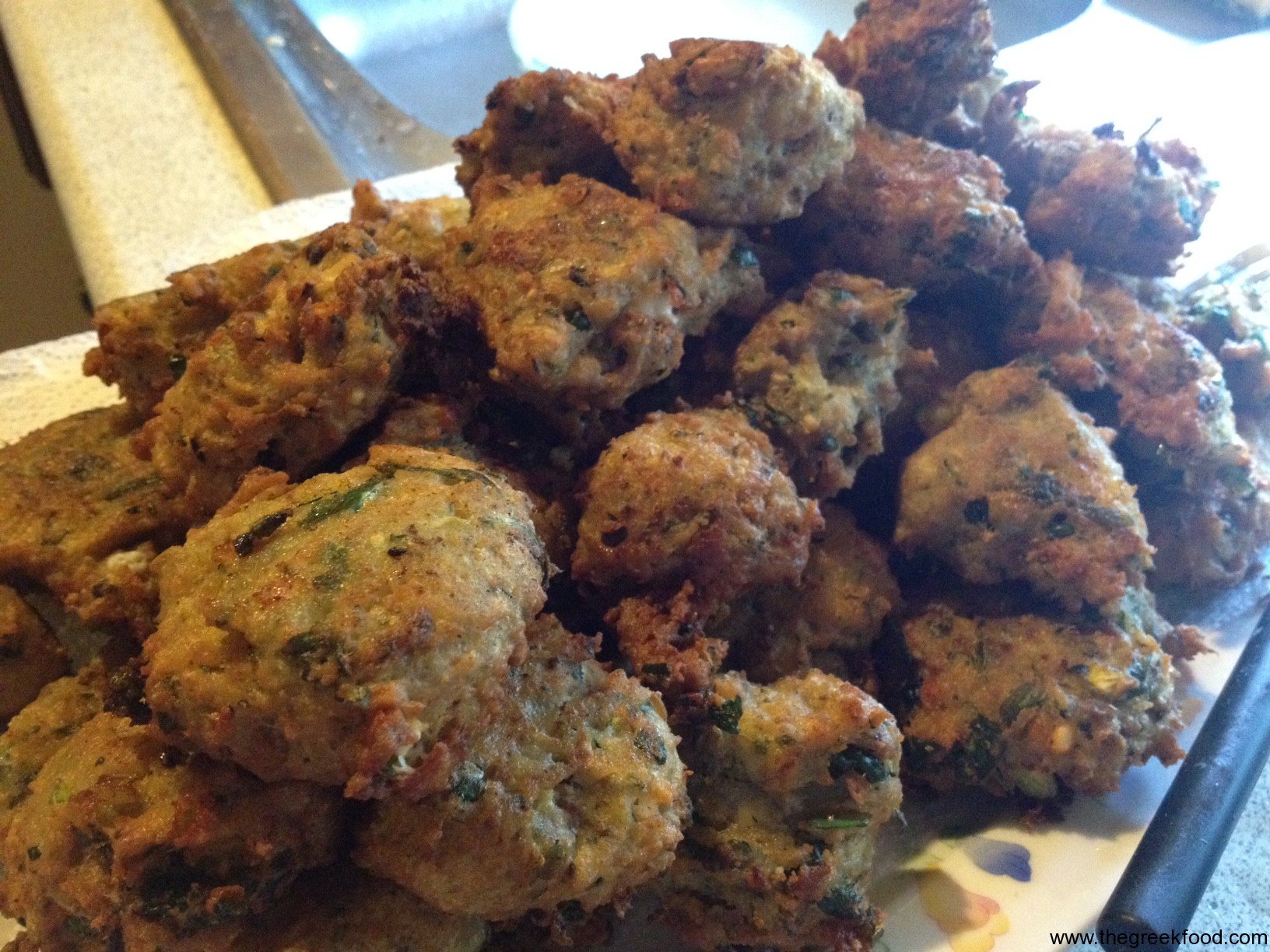
So I guess the best way to name the following dish is courgette balls! As we want to make them look like meatballs but without the meat….mmm . Be advised that even if that was our main dish that specific Sunday, it is mainly served as a side dish or appetiser in Greece.
Ingredients for Courgette Fritters
1 kilo of of medium courgettes
300gr of crumbled feta cheese
100gr of flour
Half a bunch of mint
Half a bunch of parsley
Dill (remove the stalk)
2 eggs
salt, pepper
oil for frying
Method
Grate the courgettes and leave them in a strainer. Use your hands to drain them even more and then add them in a deep bowl.
Add the flour, feta, herbs, the 2 eggs, pepper and a bit more of salt if you want. Be careful, because the feta cheese will be either way
Gently mix them with your hands and check if you can mould them to small round burgers . If not add more flour
In a deep non sticky pan, add around 3 cm of olive oil to medium to high heat. Put some extra flour around your courgette balls and then fry them .
When you remove them add them in a plate with a kitchen paper on top to drain the liquids . Serve them with a sauce of your choice. Maybe tzatziki ?
You know there are some things that are not in the cooking books and there are not in any encyclopaedia for Greek cuisine. There are things that just come up from real life and are…just there!
When I was young one of the many foods that I hated was the so called, Lachanoprassoryzo! Ok I know you don’t understand what it is but it means, Cabbage and leek rice. Why did I hated it? Cause it had only vegetables inside and that’s something that no child can ever take!
Despite all that, when you get older, things changes and you want more vegetables into your diet in order not to feel bad about the excessive alcohol that you consumed the previous night… So the previous weekend I remembered about this recipe and in fact I found details in some papers with recipes that my mother wrote for me when I first came in to UK.
However, here is the thing, when I checked around in the net to make sure that my mother has written the recipe correctly , I never found a similar recipe!. It was either cabbage rice or leek rice the typical greek recipe. I was angry! So I asked my mother to explain herself! I couldn’t believe that all those years I was brought up with a recipe that it wasn’t cooked as thousands and thousands of years before!!! Surely there had to be a reason!
According to her , the traditional recipe is either cabbage rice or leek rice but once my father had the idea to “marry” all of the ingredients into one dish and she how it will come up adding also carrots.
To be honest I am sure my father heard that story somewhere else also, but it was a good story to tell , I think 🙂
CABBAGE AND LEEK RICE (LACHANO PRASSO RIZO)
1 medium but beautifull cabbage sliced
3-4 leeks cut in rounds
2 (sweet) little carrots cut in small rounds
1 cup of -extremely- white rice (more or less for 2 people)
A small -cute- bunch of parsley, chopped
Salt and pepper
A teaspoon of olive oil
(red hot) Chili peppers (not necessary, if we want)
The juice from half a lemon
Update 5/12/2013
My brother complain recently that the recipe wasn’t clear enough. So he couldn’t how to make the food now that he lives 2 blocks away from in London. I guess he was right but i will not tell him that. I think i was more caught in the history of this dish rather than how to make it. So, lets makes it clearer.
In a big pot put a bit of olive and in medium heat throw the leeks inside that you have cut before in small round pieces. Let them sizzle for 3-4 minutes and then add, the cabbage, the parsley and stir really good.
Add some water to cover the cabbage, the carrots and let it boil for around 20-30 minutes. Basically until you see the cabbage and the carrots to start and become softer.
Add the rice, and then add more water if needed, in order to cover the rice. stir a bit more and let it boil for 15-20 minutes.
Remove the water with a strainer and serve it adding some lemon.
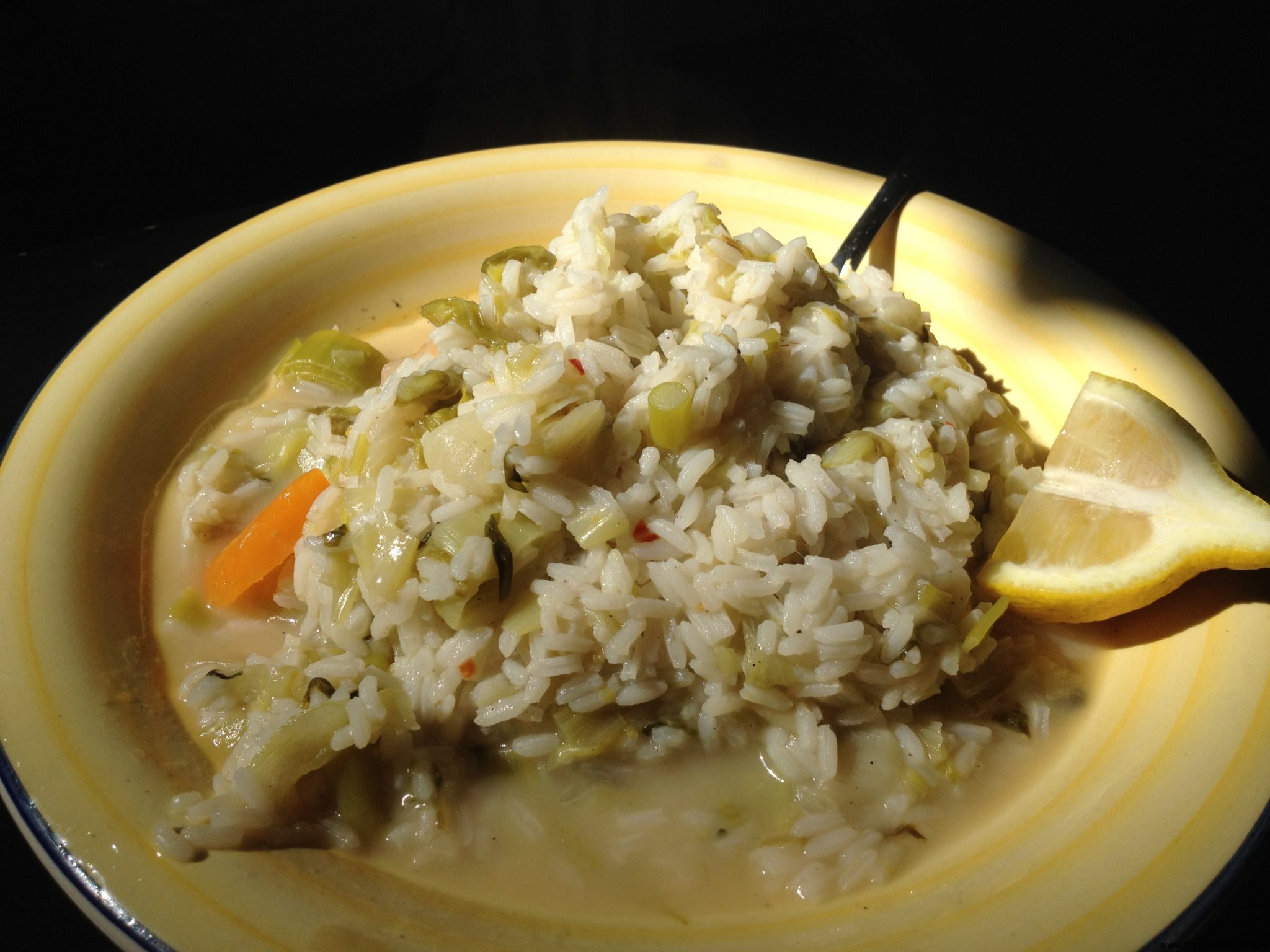
Unfortunately in the picture is not really clear…but the more vegetables, the better rather than rice.. either way enjoy it! 🙂
Ok, this post is special because it is written while being in Greece where I spent my holidays for this year. In addition to that talks about one of the most well-known Greek foods around the world, the famous….(drums)… moussaka!
Writing an article about moussaka was in my mind for a long time but always postponed. There were a lot of things that I had to learn before. Basically, how to make mousaka…
Even if there are a lot of recipes out there, I have to say it doesn’t look, and as far as I asked its not the easiest food either. However, after the first day in Greece for my holidays this year it I remembered again why everyone really loves this dish…
Every time when I return to Greece, my mother asks me what I want her to cook for me to eat on the first day. Usually my favorite choice is stuffed vegetables or in greek, “gemista”. This time it was different, I asked from my mother to cook the famous Greek mousaka so i can have the recipe from her and hopefully, one day I will manage to make something close to that…
That’s the ultimate prize ladies and gentleman! When you master moussaka, (and the cheesepie, and the spinach pie, and the gemista, and the mayiritsa, and making a greek lamb, and the fasolada…and some others) then you have mastered the Greek kitchen…So, yes i haven’t managed to cook it here in London but i am hoping in the future. Its the first time i post a recipe before cooking it …but ok its a special food also. My cooking powers are not yet fully developed ….
Well, anyway, here is the recipe straight from my mother…old school…
Some notes, she finds it difficult to put down exact quantities as she has used to do everything by experience . Despite that the quantities here should be more than enough for 4 people. As she always tells me, small changes on the recipe don’t really matter…eventually you will get there.
The famous Greek Mousaka
INGREDIENTS FOR MOUSSAKA RECIPE
700 gr potatoes
700 gr courgettes
700 gr Aubergines
700 gr minced meat
1 large onion chopped
1/2 cup of oil
3 tablespoons of tomato paste
1 glass of red wine (but if you like yellow we won’t get angry)
1/2 glass of water
1 vegetable stock cube
Chopped Parsley
Salt and Pepper
INGREDIENTS FOR THE BECHAMEL CREAM
3 tablespoons of butter
410ml of milk. (1 can of milk)
820ml water (My mother just fills two times with water the empty box of milk… 🙂 )
1 vegetable stock cube
300gr flour
2 beaten eggs
5 tablespoons of grated cheese
grated nutmeg
salt and pepper
HOW TO COOK MOUSSAKA
We shall begin by preparing the aubergines. Remove the stalks from them and cut them into slices, 1 cm thick. Season with salt and let them on the side.
Drizzling the aubergines with some olive oil and bake them for 20 minutes. Do exactly the same with potatoes and the courgettes.
Prepare the meat sauce for the moussaka. Heat a large pan to medium -high heat and add the olive oil. Stir in the chopped onions and sauté, until softened and slightly colored. Stir in the garlic, tomato puree and the mince breaking it up with a wooden spoon and sauté. Pour in the red wine and wait to evaporate.
Add the tinned tomatoes, vegetable cubes, chopped parsley and a good pinch of salt and pepper. Bring to the boil, turn the heat down and simmer with the lid on for about 30 minutes, until most of the juices have evaporated.
Now it gets tricky! Time to prepare the béchamel sauce. Use a large pan to melt some butter over low-medium heat. Add the flour whisking continuously to make a paste. Keep adding warmed milk in a steady stream while in the same time you keep whisking in order to prevent your sauce from getting lumpy.
Remove the pan from the stove and stir in the egg yolks, salt, pepper, a pinch of nutmeg and the grated cheese. Whisk quickly, in order to prevent the eggs from turning an omelette!
Now its time to build the moussaka!
You will have to get a large baking dish and butter the bottom and sides of the pan before you start adding the layers of the vegetables. First the potatoes, then the aubergines, and on top of them the courgettes.
Pour in the meat sauce and even out. Add a second layer of eggplants, topping with the béchamel sauce.
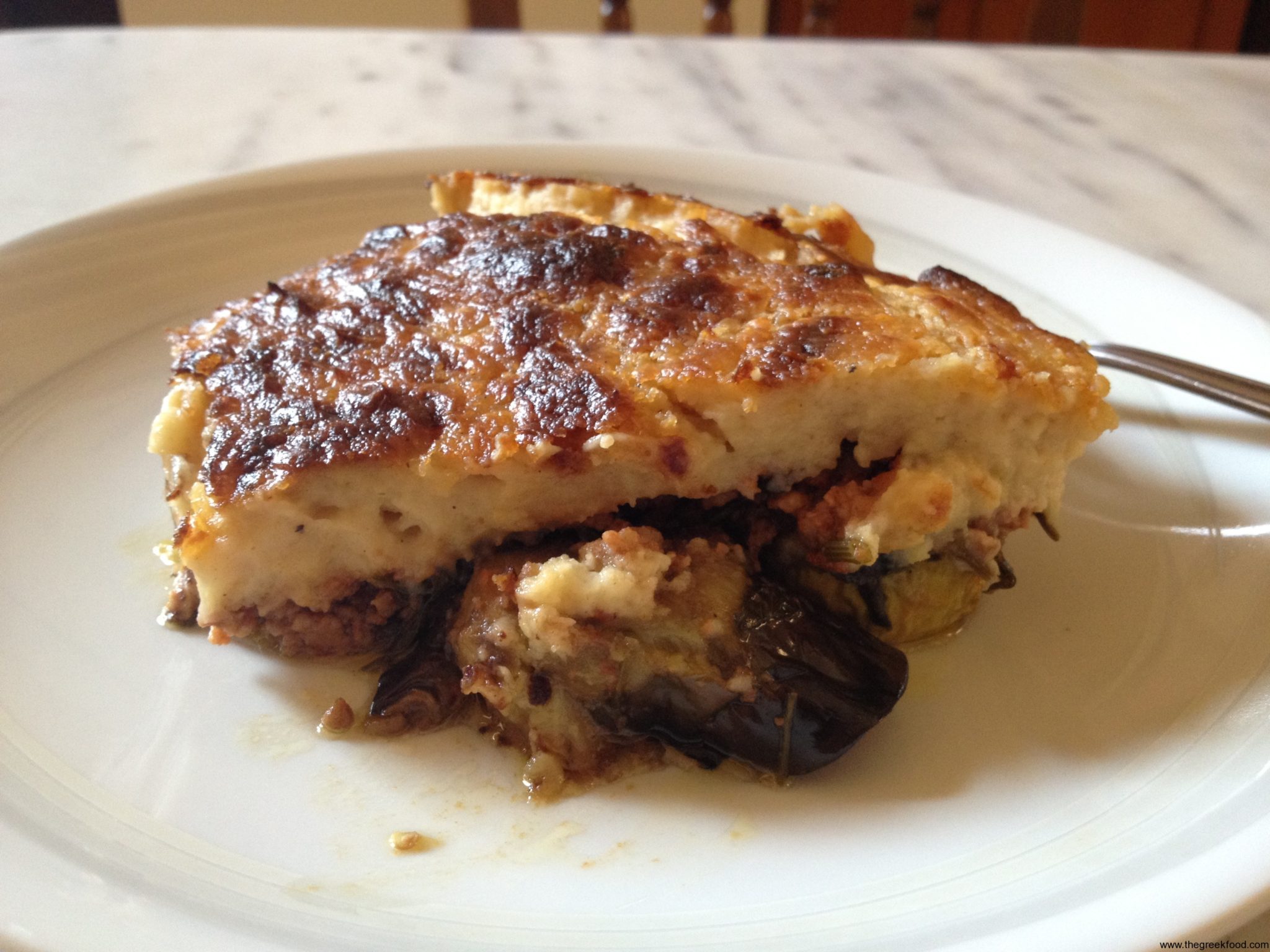
Finally, sprinkle with grated cheese and bake the musaka in preheated oven at 180-200C for about 60 minutes, until crust turns light golden brown.
Make sure you wait until the moussaka gets cold a bit as it will be difficult to eat otherwise.!
Going in a restaurant in Greece to eat sometimes suprises me to see how many different salads exist that I have never tried. Surely most know the typical Greek salad or “country salad” as it is also said but there are so many more.
Especially during summer it is ideal to try as many as possible as they are fresh and so tasty to combine them with any food. On the other hand having a salad with beet roots wasn’t something that I really had in mind but it is always nice to experiment.
When I was younger I never liked beetroots because of that red liquid they get out when you eat them or cut them. Minor details now I say…
They make excellent salads, and this is one way to eat them.